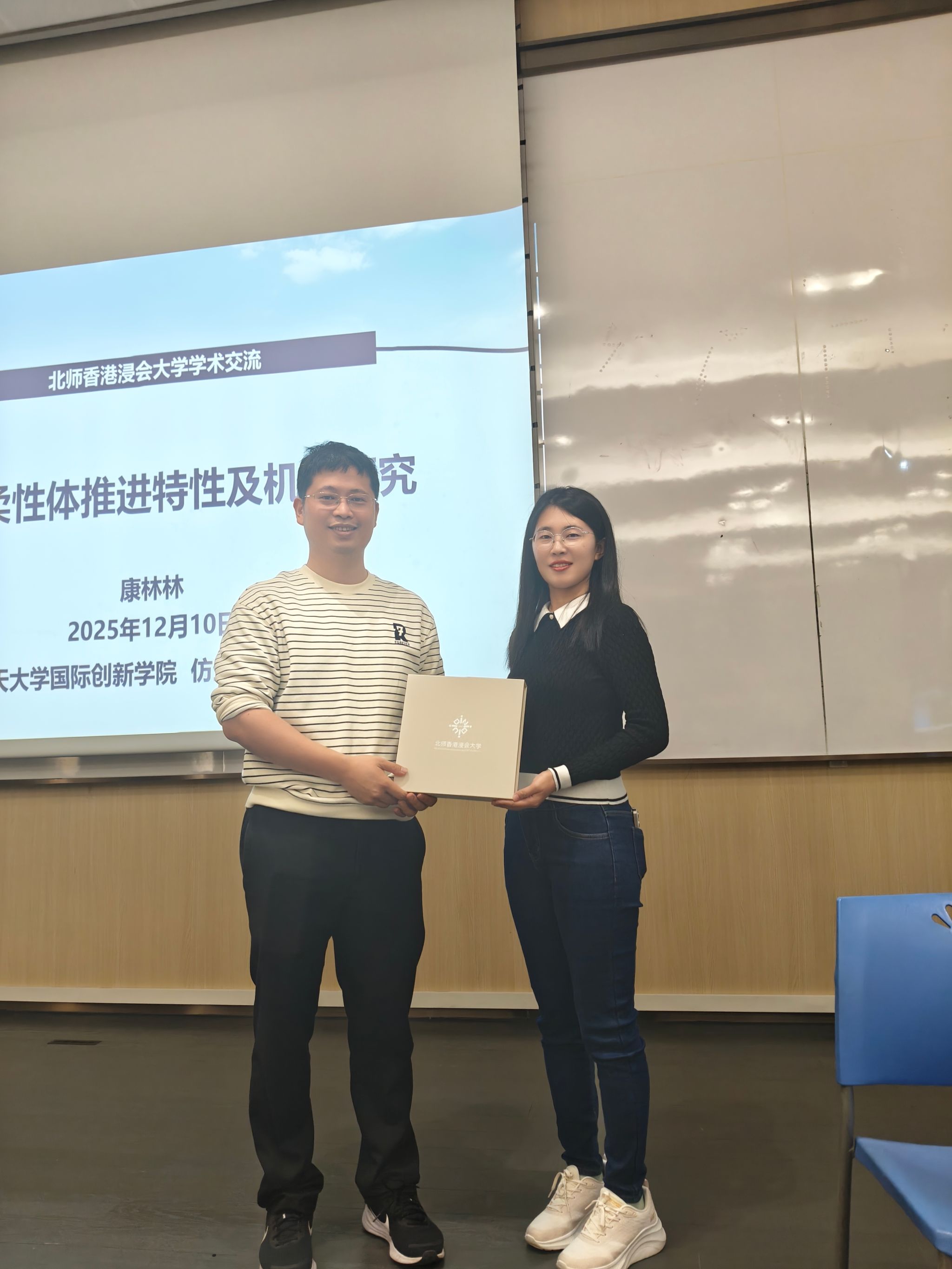
Speaker: Dr. Linlin Kang(康林林博士)
Time: 10:30-11:50, 10 December 2025 (Wednesday) (Beijing time)
Venue: T7-105, BNBU
Abstract
The efficient swimming mechanism of aquatic organisms such as fish is not only a cutting-edge interdisciplinary topic in the field of fluid mechanics but also provides a natural biomimetic model for the development of eco-friendly aquatic monitoring equipment. Against the backdrop of increasingly urgent demands for aquatic ecological protection and environmental monitoring, problems such as easy disturbance to the water environment and low propulsion efficiency of traditional monitoring equipment need to be solved urgently. Fish swimming involves complex unsteady vortex dynamics, fluid-structure interaction, and flow control mechanisms, and the revelation of relevant laws is crucial for the research and development of biomimetic equipment. Guided by the "low-disturbance and high-efficiency" ecological monitoring requirements, this study develops a local vortex dynamics theory based on the Navier-Stokes equations, establishes a quantitative relationship between the forces acting on flexible bodies and the formation and evolution of local vortex structures, and clarifies the physical process by which the interaction between vortices and flexible plates affects propulsion performance. It focuses on studying the influence of key parameters such as the driving mode and structural characteristics of flexible bodies on their propulsion performance, motion stability, vortex-body interaction mode, and wake vortex structure in a simulated natural water environment, with special attention to the protective effect of low-disturbance wake on aquatic biological habitats. This research not only deepens the understanding of the dynamic mechanism of biomimetic flexible body motion but also provides core theoretical support for the development of biomimetic vehicles suitable for scenarios such as sensitive water area ecological monitoring and pollutant traceability, helping to realize the coordinated development of environmental monitoring and ecological protection.
About the Speaker
Kang Linlin is an Associate Professor at the International School of Innovation, Beihang University. She serves as a Young Editorial Board Member for journals including Chinese Journal of Gas Physics, Journal of Astronautics, and Theoretical and Applied Mechanics Letters (TAML). Her research interests focus on the intersection of biomimetic fluid mechanics, vortex dynamics, and ecological engineering, covering fields such as micro flapping-wing flight design and the development of eco-friendly biomimetic underwater vehicles. She has published 29 SCI papers in prestigious journals such as Journal of Fluid Mechanics, and AIAA Journal.
Dr. Kang was selected into the Young Talent Support Program of the Zhejiang Association for Science and Technology. She currently hosts several research projects, including the General Program and Young Scientists Fund of the National Natural Science Foundation of China (NSFC), the China Postdoctoral Science Foundation General Program, and the Exploration Program of the Zhejiang Provincial Natural Science Foundation, with part of the research funds dedicated to the integration of biomimetic technology and aquatic ecological protection.